


Most pricing conversations start with the number.
Too high.
Too low.
Should we discount?
Should we test a new price point?
But consumers don’t experience price as a number.
They experience it as a signal, and that signal is interpreted emotionally, socially, and contextually, often before conscious reasoning ever kicks in.
When someone says, “This is too expensive,” what they’re really saying is:
I’m not sure what this means for me.
The Problem With How We Think About Price
Brands tend to treat price objections as rational barriers:
The price exceeded willingness to pay
The customer didn’t see the value
The competitor is cheaper
But consumer behavior research shows something different.
Price is not evaluated in isolation.
It’s interpreted through mental shortcuts, past experiences, and social meaning.
That’s why the same price can feel:
Fair to one person
Excessive to another
Reassuring to a third
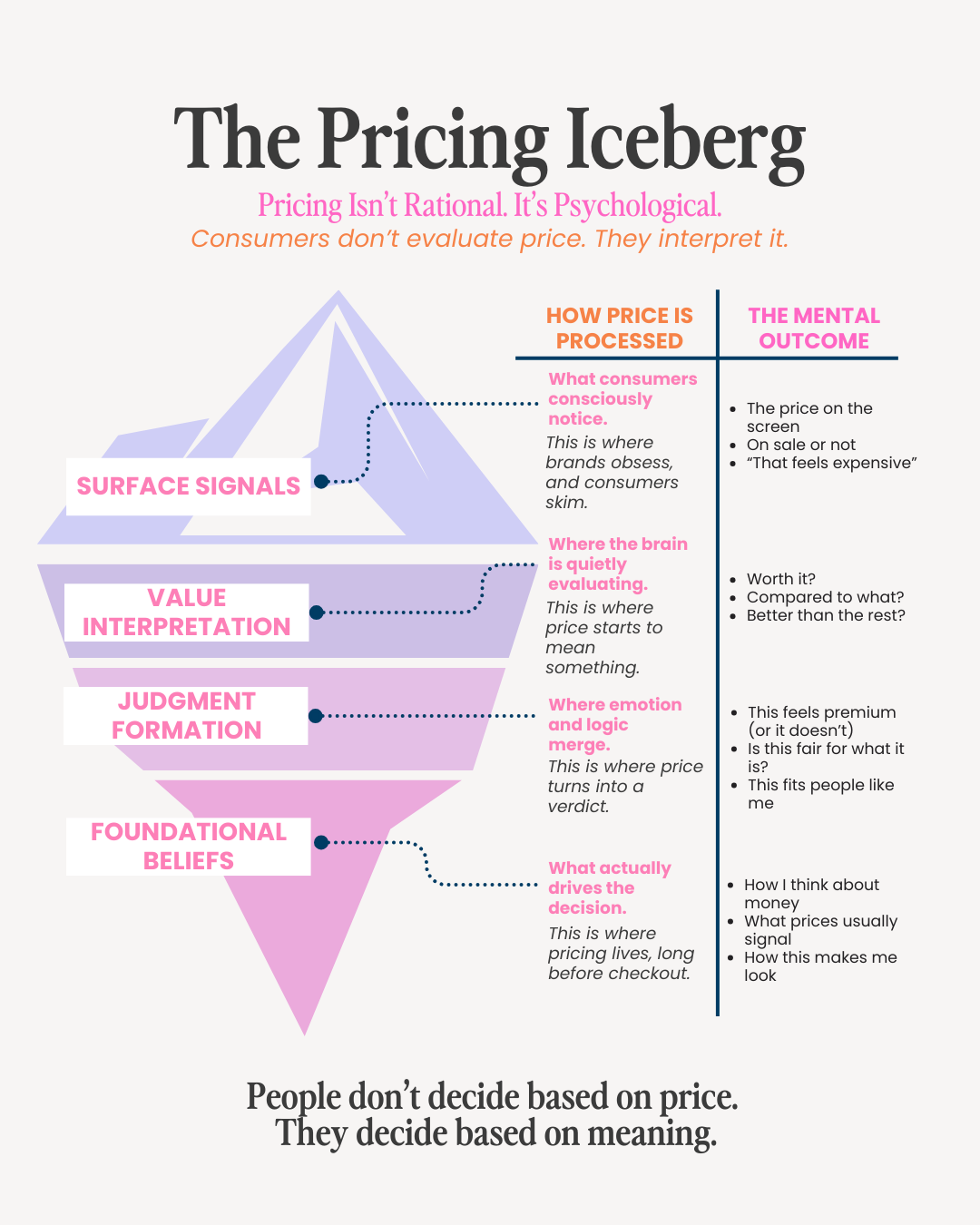
This is where the Pricing Iceberg comes in.
The Pricing Iceberg (Explained Simply)
What we see on the surface is small:
The number
A discount
A quick gut reaction
But below that surface, several things are happening simultaneously.
Price moves through layers of interpretation:
Is this worth it compared to other options?
Does this feel fair for what I’m getting?
What does this say about quality?
Does this brand fit people like me?
And beneath all of that are foundational beliefs:
How someone was taught to think about money
What certain prices typically signal
How price affects identity and perception
By the time someone reaches checkout, the decision has often already been made, quietly, below awareness.
A Real-World Example (Beauty / Wellness Friendly)
Think about a premium skincare product.
Two brands.
Similar ingredients.
Very different prices.
One feels “worth it.”
The other feels “overpriced.”
The difference usually isn’t the formula.
It’s the meaning created by:
Packaging
Brand voice
Social proof
Visual cues
Who is seen using it
The higher price doesn’t persuade.
It reassures.
It signals quality, intention, and belonging.
That’s the iceberg at work.
Why Discounts Often Miss the Point
When brands respond to hesitation by discounting, they’re addressing the surface, not the cause.
Discounts may create short-term action, but they don’t fix:
Unclear value
Trust gaps
Identity mismatch
Decision fatigue
In many cases, lowering the price actually adds doubt:
Why is this suddenly cheaper? What changed?
If price doesn’t make sense emotionally, it won’t make sense financially.
The Reframe Brands Need
Pricing isn’t about convincing people to pay more.
It’s about helping them understand:
What they’re paying for
Why it matters
What it signals about them
When price is clear in meaning, it feels fair.
When it feels fair, resistance drops.
When resistance drops, conversion follows.
People don’t decide based on price.
They decide based on meaning.
Once you start seeing price as a psychological signal, not a numeric hurdle, pricing decisions change.
So does messaging.
So does positioning.
So does how you interpret “too expensive.”
The iceberg was always there.
Most brands just weren’t looking below the surface.